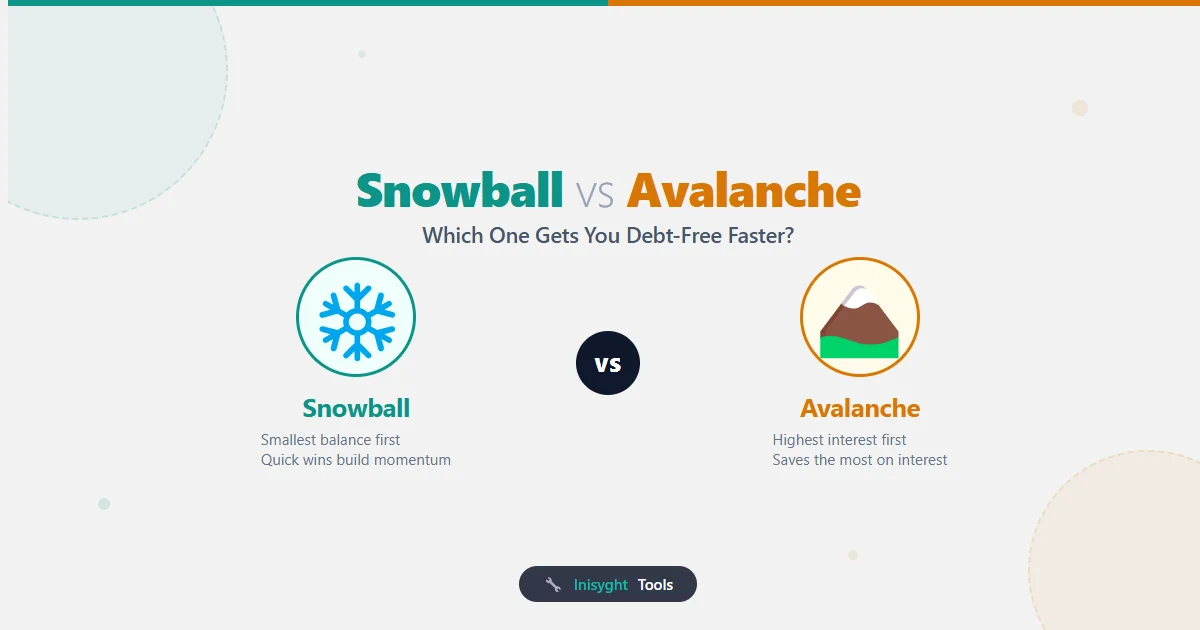
Snowball vs Avalanche: Which Debt Payoff Strategy Is Right for You?
Two proven methods. One big difference: what keeps you going. Here's how to pick the one you'll actually finish.
You've decided to get out of debt. That's the hardest part — and you've already done it. Now comes the next question: which payoff strategy should you use?
If you search online, you'll find two names over and over: the Debt Snowball and the Debt Avalanche. Both work. Both have helped thousands of people become debt-free. But they take very different paths to get there.
In this guide, we'll break down how each method works, which one saves you more money, and — most importantly — which one you're likelier to finish.
❄️ What Is the Debt Snowball Method?
The Debt Snowball was popularized by financial author Dave Ramsey. Here's how it works:
- List your debts from smallest balance to largest — ignore interest rates.
- Pay the minimum on every debt except the smallest one.
- Throw every extra dollar at that smallest debt until it's gone.
- Roll that payment to the next smallest debt. Repeat until you're debt-free.
The idea is momentum. Each time you wipe out a small balance, you get a psychological win. That win fuels your motivation to tackle the next one.
Pros of the Snowball
- ✅ Quick wins. You feel progress early, which keeps you going.
- ✅ Simple. No math required. Just smallest to largest.
- ✅ Behavioral advantage. The HBR study proves motivation matters as much as math.
Cons of the Snowball
- ❌ Costs more interest. You may pay more over time because you're not targeting high-interest debts first.
- ❌ Takes longer. In some cases, you'll carry high-interest debt longer, which means more total interest paid.
🏔️ What Is the Debt Avalanche Method?
The Debt Avalanche is the mathematician's favorite. It's all about efficiency. Here's the process:
- List your debts from highest interest rate to lowest — balance doesn't matter.
- Pay the minimum on everything except the highest-rate debt.
- Put all extra money toward that high-rate debt until it's gone.
- Roll that payment to the next-highest rate. Repeat until done.
The avalanche minimizes the total interest you pay. Every dollar you put toward the highest-rate debt saves you more than putting it toward a lower-rate one.
Pros of the Avalanche
- ✅ Saves the most money. You pay less in total interest over the life of your debts.
- ✅ Fastest in pure math terms. You'll be debt-free sooner — if you stick with it.
- ✅ Logical. If you're numbers-driven and disciplined, this makes perfect sense.
Cons of the Avalanche
- ❌ Slow starts. Your highest-rate debt might be your largest one. It can take months or years to see a first victory.
- ❌ Easy to quit. Without quick wins, some people lose motivation and give up entirely.
📊 Snowball vs Avalanche: Side by Side
| Factor | ❄️ Snowball | 🏔️ Avalanche |
|---|---|---|
| Order | Smallest balance first | Highest interest rate first |
| Total interest paid | Higher | Lower ✅ |
| Time to first win | Fast ✅ | Can be slow |
| Motivation factor | High ✅ | Depends on personality |
| Best for | People who need momentum | People who love efficiency |
| Complexity | Simple ✅ | Simple ✅ |
🔬 What Does the Research Say?
A 2016 study published in the Harvard Business Review by researchers Remi Trudel, Kyle Murray, and colleagues tested different debt-payoff strategies. Their finding: people who paid off the smallest balance first (the snowball method) were significantly more likely to eliminate their entire debt load than those who targeted high-interest debts first.1
The reason? Motivation. Small victories create a sense of progress, which keeps people engaged. The researchers called it "the power of small wins."
On the other hand, a 2020 analysis from James Madison University (McAllister, 2020) found that the avalanche method is mathematically more efficient in the majority of cases — but the snowball method is a "very close competitor" that offers psychological benefits that can matter more than pure math.2
🤔 So… Which One Is Right for You?
Here's an honest answer: The best method is the one you'll actually stick with.
Choose the Snowball if:
- You've tried to get out of debt before and quit.
- You need visible progress to stay motivated.
- You want a simple system that doesn't require spreadsheets.
- The behavioral momentum of quick wins sounds appealing.
Choose the Avalanche if:
- You're disciplined and numbers-driven.
- You have high-interest credit card debt you want to crush.
- You want to minimize every dollar of interest paid.
- You can stay motivated without early wins.
And here's a secret: You can switch. Start with the snowball to build momentum, then switch to avalanche for the heavy lifting later. The only rule is keep going.
🧮 Try Both Methods — Side by Side
Enter your debts in our free calculator and compare snowball vs avalanche instantly. See which one saves you more money and how fast you can be debt-free.
🚀 Open the Debt Payoff Calculator →💪 3 Tips to Stay on Track
- Track every win. Put a checkmark on the calendar each time you make an extra payment. Visual progress is powerful.
- Automate your payments. Set up auto-pay for at least the minimum on all debts. This removes the "will I do it?" question.
- Celebrate milestones. When you pay off a debt, do something small to celebrate — a nice dinner, a movie night. You earned it.
📝 Bottom Line
Both the Debt Snowball and Debt Avalanche are proven, effective ways to get out of debt. The snowball wins on motivation; the avalanche wins on math. Neither is "wrong."
The most important thing is to pick one and start today. Not next month. Not when you have more money. Today.
Open our Debt Snowball & Avalanche Calculator, enter your debts, and see the difference for yourself. Then take the first step.